
Introduction
Simple Home Security Systems help Gainesville homeowners protect what matters most without adding unnecessary complexity. For many retirees, home security is about creating a home that feels easier to manage, more predictable, and more reassuring every day.
That perspective changes how an effective security system should be designed.
A security system may include excellent cameras, alarms, smart locks, and mobile applications, but those features provide little long-term value if the homeowner finds the system confusing or difficult to use. The most effective residential security systems are designed around the people living in the home. They support familiar routines, provide clear information, and remain dependable without requiring constant attention.
For retirees throughout Gainesville, Ocala, Newberry, Tioga, Haile Plantation, Jonesville, and surrounding North Central Florida communities, priorities often differ from those of younger households. Some homeowners spend more time at home and want better awareness of visitors, deliveries, or activity around the property. Others travel frequently and want confidence that their home remains protected while they are away. Many want technology that adult children or trusted caregivers can help manage without taking control away from the homeowner.
The goal is not to make homeowners feel monitored. It is to help them feel supported.
Consider a retired couple living in Gainesville. They enjoy traveling several times each year, but they also spend much of their time at home. During an ordinary week, packages arrive, neighbors stop by, landscapers work around the property, and service professionals occasionally need access. A security system designed only around burglary detection would address only a small portion of what matters to them.
A better system provides awareness throughout the day. The homeowners can see who is approaching the front door, verify that a service technician arrived as scheduled, confirm that the garage door is closed, and check the property while traveling. If an alarm or life-safety event occurs, the system communicates clearly and follows an established response process.
This type of protection supports independence rather than complicating it.
The National Institute on Aging notes that many older adults want to remain in their own homes as they age. Achieving that goal often requires thoughtful planning around safety, accessibility, communication, and support. A professionally designed security system can become one part of that broader aging-in-place strategy by helping homeowners remain informed without forcing them to manage unnecessary complexity.
Homeowners beginning this planning process should first review Home Security Systems Gainesville, which explains how professionally integrated alarms, cameras, smart locks, video doorbells, and automation can work together as one coordinated residential security system.
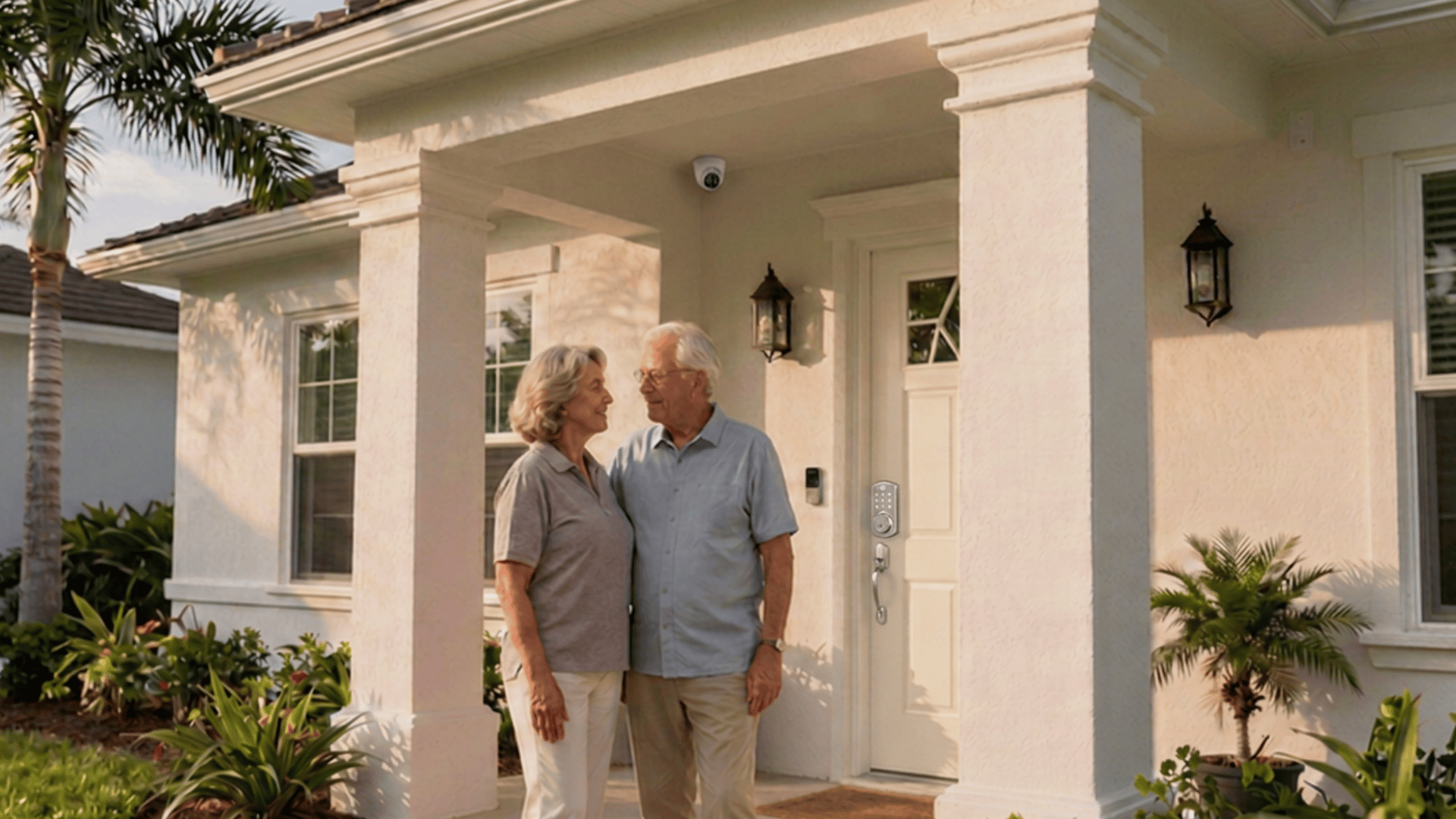
Simple home security systems support independence by providing clear information without unnecessary complexity.
Why Retirees Need a Different Approach to Home Security
Retirees do not necessarily face completely different security risks from other homeowners, but they often use their homes differently. That changes how the system should be designed.
A household with school-aged children may prioritize after-school arrival notifications, frequent guest access, and activity around several entrances. A retired homeowner may place greater value on identifying unexpected visitors, confirming that exterior doors are secured, managing access for family members, and maintaining awareness during travel.
The difference is not the amount of protection required. It is the way that protection should operate.
Imagine a homeowner in Haile Plantation who spends most mornings at home. Around noon, someone approaches the front door and rings the bell. With a traditional doorbell, the homeowner must either walk to the entrance or ignore the visitor without knowing who is outside.
A professionally integrated video doorbell changes that interaction. The homeowner receives a clear notification, views the visitor on a tablet or smartphone, and decides whether to speak with them or leave the door closed. If the person claims to represent a utility company or service provider, the homeowner can verify the visit before granting access.
This type of awareness is especially important because unexpected visitors sometimes create pressure or urgency. The Federal Trade Commission warns that deceptive home-security sales representatives may falsely claim that a homeowner’s current security company has closed or that equipment must be replaced immediately. The FTC recommends contacting the existing monitoring company directly before signing anything or allowing unverified representatives into the home.
A well-designed security system supports that cautious decision-making process. Video provides identification. Two-way communication allows the homeowner to respond without opening the door. Recorded footage creates documentation if questions arise later.
Retirees also tend to benefit from security systems that provide clear information rather than constant alerts. A notification should help answer a question:
- Who is at the door?
- Was the garage opened?
- Did the house cleaner arrive?
- Is the backyard gate still open?
- Did the alarm system arm successfully?
When technology answers those questions clearly, it supports confidence. When it sends dozens of vague notifications, it creates distraction.
The best systems are therefore not the ones with the largest number of features. They are the ones designed to deliver useful information in a way the homeowner can understand and trust.
Retirees evaluating a complete system should also review ConnectSmart Systems’ residential security services, which describe how professional planning, installation, monitoring, and support work together over the life of the system.
Simplicity Is a Security Feature
Security systems are often compared by the number of devices or features they include. For retirees, that can be the wrong comparison.
A feature provides value only when the homeowner understands it and uses it consistently.
Imagine a system that requires separate applications for the alarm, cameras, smart lock, and video doorbell. A homeowner receives a motion alert, opens one application, realizes the video is stored somewhere else, and then searches for another password. By the time the information appears, the event has passed.
The homeowner may eventually stop checking alerts altogether.
That is not a failure of the equipment. It is a failure of system design.
A professionally integrated system should reduce the number of steps required to understand an event. When the front-door camera detects a visitor, the homeowner should receive a clear notification and be able to view the video immediately. When the alarm system reports an open door, the homeowner should be able to identify the location and understand what action is needed.
Simple operation does not mean limited capability.
A system can include sophisticated cameras, professional monitoring, smart locks, environmental sensors, and home automation while still presenting the homeowner with an uncomplicated experience. The complexity should exist behind the scenes, where the system designer and service provider manage it. The homeowner should experience clarity.
This becomes particularly important when adult children or caregivers provide occasional assistance. The homeowner may want a family member to receive selected alerts or help manage the system during travel without receiving access to every function. Professional platforms can often assign different permission levels so each person receives only the access appropriate to their role.
For example, an adult daughter may receive emergency notifications while her parents remain the primary users. A trusted neighbor may receive a temporary smart-lock code during vacation without gaining access to alarm settings or camera history. These distinctions support independence while creating a reliable support network.
Cybersecurity should also remain simple and manageable. The Cybersecurity and Infrastructure Security Agency recommends using strong, unique passwords, enabling multifactor authentication when available, and keeping connected devices updated. A professional installer can help configure these protections and explain them in clear language rather than leaving the homeowner to manage every setting alone.
Retirees who want professional guidance without unnecessary technical complexity can learn more about ConnectSmart Systems’ experience on the company’s About page, which describes more than 20 years of designing, installing, maintaining, and monitoring security systems.
A professionally integrated system can provide advanced protection through one clear, easy-to-use interface.
Designing Security Around Daily Routines
A strong home security plan begins by understanding what an ordinary day looks like.
- When does the homeowner leave the house?
- Which entrance is used most often?
- Do family members visit regularly?
- Are there scheduled caregivers, cleaners, landscapers, or service technicians?
- Does the homeowner travel for extended periods?
- Are there detached buildings, gates, or garage entrances that need attention?
These questions often reveal more useful information than a simple count of doors and windows.
Consider a retired couple in Ocala who use the garage entrance almost exclusively. The front door is reserved for visitors, while the rear patio is used throughout the day. A standard package designed around the front entrance would overlook the way the homeowners actually move through the property.
A professionally designed system would likely place greater emphasis on the garage entry, rear patio, driveway, and front-door visitor awareness. The alarm might be programmed so the homeowners can secure selected parts of the home at night while still moving comfortably through occupied areas.
The same principle applies to notifications. A front-door delivery at two o’clock in the afternoon may be routine. Movement near a side gate at two o’clock in the morning is not. The system should help the homeowner distinguish between ordinary and unusual activity instead of treating every event identically.
Daily routines also influence camera placement. A camera facing the front door should be positioned to identify visitors rather than simply recording the top of someone’s head. A driveway camera should provide useful vehicle and approach information. Indoor cameras, when appropriate, should be limited to common areas where they support awareness without intruding on privacy.
The National Institute on Aging recommends evaluating the home environment as part of aging-in-place planning, including lighting, walking areas, access points, and other conditions that influence safety and independence. Security planning should follow the same individualized approach rather than relying on standard equipment packages.
The purpose is not to fill the home with devices.
It is to place the right technology in the right locations so the homeowner receives dependable protection without changing comfortable routines.
Visitor Awareness and Front-Door Security
For many retirees, the front door has become one of the most important areas of the home to protect—not because of increased crime, but because it is where everyday interactions occur.
Packages arrive.
Neighbors stop by.
Family members visit unexpectedly.
Contractors perform scheduled work.
Delivery services have become part of daily life.
Unfortunately, the front door is also where deceptive salespeople and scammers often attempt to create urgency or gain access to the home.
A professionally designed video doorbell changes how homeowners respond to these situations.
Instead of reacting immediately to someone knocking at the door, the homeowner first gains information. They can see who is outside, communicate through two-way audio, and decide whether opening the door is appropriate.
Imagine a retired homeowner in Gainesville enjoying a quiet afternoon while reading on the back patio. The doorbell rings unexpectedly. Rather than walking immediately to the front entrance, the homeowner opens the ConnectSmart mobile application, views the visitor, and discovers that it is simply a package delivery. Minutes later, another visitor arrives claiming to represent a utility company. Before opening the door, the homeowner verifies that no service appointment was scheduled and politely requests identification through the video doorbell.
The homeowner remains in complete control throughout both interactions.
This ability to verify visitors before opening the door provides reassurance while reducing unnecessary risk.
Professionally installed video doorbells also create a visual history of activity around the entrance. Homeowners can review deliveries, verify that contractors arrived when expected, or determine whether family members visited while they were away. These recordings often prove valuable during ordinary situations rather than emergencies.
Front-door security also extends beyond the doorbell itself. Exterior lighting, camera placement, landscaping, and visible house numbers all contribute to making the entrance safer and easier to monitor. Motion-activated lighting improves nighttime visibility, while properly positioned cameras provide a clear view of approaching visitors rather than simply recording activity after someone reaches the porch.
The Crime Prevention Through Environmental Design (CPTED) philosophy emphasizes natural surveillance and visibility as important components of residential security. A well-designed front entrance allows homeowners to observe activity comfortably while discouraging opportunistic criminal behavior through improved visibility and thoughtful environmental design.
If your current front entrance still relies solely on a traditional doorbell, this area often represents one of the easiest and most valuable improvements homeowners can make. A professionally integrated video doorbell becomes far more than a camera—it becomes a communication tool that supports everyday confidence.
To learn more about designing a complete residential entry solution, homeowners should also review Video Doorbells and Front Door Security, which explains how cameras, smart locks, lighting, and monitored security work together to protect the most frequently used entrance to the home.
Video doorbells allow homeowners to identify visitors and communicate safely before opening the door.
Alarm Monitoring and Emergency Communication
While security cameras help homeowners understand what is happening around their property, professionally monitored alarm systems answer a different question:
What happens when the homeowner cannot respond?
This distinction becomes especially important for retirees.
Imagine a homeowner traveling with family when an intrusion alarm activates unexpectedly. Cameras allow the homeowner to review activity remotely, but professional monitoring provides another layer of protection by following an established response plan if assistance becomes necessary.
The same principle applies to life-safety devices.
Professionally monitored smoke detectors, carbon monoxide detectors, and other environmental sensors continue protecting the home whether the homeowner is sleeping, traveling, or simply unable to respond immediately.
This layered approach reduces reliance on one individual making every decision during a stressful situation.
Emergency communication should also remain simple.
When a notification appears, homeowners should immediately understand:
- What happened.
- Where it happened.
- Whether immediate action is necessary.
- Whether professional monitoring has already begun responding.
Confusing notifications create unnecessary anxiety. Clear communication builds confidence.
For retirees living independently, monitored systems also provide reassurance to adult children. Family members know that professionally trained operators are available if significant alarm events occur, rather than relying exclusively on a relative to answer every notification personally.
Professional monitoring also supports homeowners during severe weather events common throughout North Central Florida. Although no security system prevents storms, monitored devices help notify homeowners of developing conditions inside the home, allowing faster response to smoke alarms, environmental alerts, or other emergencies requiring attention.
The National Fire Protection Association (NFPA) continues to emphasize the importance of properly installed and maintained smoke alarms throughout residential properties. Integrating those devices into a professionally monitored security platform increases the likelihood that emergency events will receive timely attention, even when homeowners are away.
For homeowners evaluating complete residential protection, our guide Best Alarm Systems for Residential Homes explains how monitored intrusion detection, life-safety devices, and integrated surveillance work together to provide comprehensive protection instead of operating independently.
Is Your Current Security System Keeping Up With Your Lifestyle?
Many retirees installed their first alarm system years ago. While those systems may still function, they often operate independently from cameras, video doorbells, smart locks, and today’s mobile applications.
A professionally integrated system brings these technologies together into one coordinated platform that is easier to understand, easier to manage, and designed to support everyday independence rather than adding unnecessary complexity.
Whether you’re planning to remain in your current home for many years or preparing for more frequent travel during retirement, a professionally designed security system can evolve alongside your lifestyle while continuing to provide dependable protection.
ConnectSmart Systems proudly helps homeowners throughout Gainesville, Ocala, Newberry, Tioga, Haile Plantation, Jonesville, and surrounding North Central Florida design residential security solutions that emphasize simplicity, reliability, and long-term peace of mind.
Cameras That Provide Confidence—Not Constant Notifications
One of the most common concerns retirees express is the fear of being overwhelmed by technology.
Many homeowners have experienced consumer camera systems that generate dozens of notifications throughout the day—every passing car, every blowing tree branch, every neighborhood cat, and every package delivery. After a few weeks, many simply stop paying attention.
A professionally designed surveillance system takes a different approach.
Rather than notifying homeowners about everything, it should notify them about the right things.
Consider a homeowner living in Tioga who receives regular deliveries, has a landscaping company every Tuesday morning, and enjoys evening walks around the neighborhood. Those activities are expected. The security system should recognize those normal patterns and help the homeowner focus on events that deserve attention rather than interrupting daily life unnecessarily.
Modern analytics, properly configured by experienced installers, can distinguish between different types of activity and organize recorded events into meaningful timelines rather than overwhelming homeowners with constant alerts.
This becomes particularly valuable during travel.
Imagine a retired couple spending two weeks visiting grandchildren in Tennessee. During that time the lawn is maintained, several deliveries arrive, and neighbors occasionally check the property. Instead of worrying each day, the homeowners can review organized activity at convenient times, confirming that everything remains exactly as expected.
Cameras therefore provide something much more valuable than video.
They provide confidence.
The purpose is not continuous surveillance.
The purpose is eliminating uncertainty.
Professional camera placement, thoughtful notification settings, and integration with the broader security system ensure homeowners receive useful information without feeling as though technology has become another responsibility to manage.
Homeowners interested in learning more should review Security Camera Installation Gainesville FL, which explains how professional planning dramatically improves the usefulness of residential surveillance compared to simply adding more cameras.
Smart Locks and Trusted Access
Retirement often brings new routines, and those routines frequently involve allowing trusted people into the home.
Family members may stop by while the homeowner is away. A housekeeper may visit on a scheduled day each week. Lawn maintenance crews, pest-control technicians, pool service companies, or home health providers may require access at different times throughout the month.
Traditionally, homeowners solved these situations by hiding spare keys, making multiple copies, or trying to coordinate everyone’s schedule. Unfortunately, each of those approaches creates uncertainty. Once a key leaves the homeowner’s possession, there is often no way to know who has access or when it might be used.
Professionally integrated smart locks provide a safer and more convenient alternative.
Instead of distributing physical keys, homeowners can create unique access credentials for individual users. A family member may receive permanent access, while a contractor receives temporary access that automatically expires after the work has been completed. If circumstances change, access can be modified or removed immediately without replacing locks or collecting keys.
Imagine a retired homeowner in Gainesville leaving for a week-long vacation. During that time, a trusted neighbor agrees to collect mail every afternoon while the lawn service continues its regular schedule. Rather than leaving hidden keys around the property, the homeowner creates two separate access permissions. The neighbor receives one credential, while the lawn service continues using exterior gates without needing entry into the home itself.
Each access event is recorded, allowing the homeowner to review exactly when doors were unlocked and by whom.
This level of visibility provides reassurance while preserving independence.
Smart locks also improve convenience during everyday life. Carrying groceries inside, returning from an evening walk, or welcoming visiting grandchildren becomes easier when secure access no longer depends entirely on traditional keys.
Professional installation remains important because locks should integrate with the broader security platform. Door status, alarm arming, surveillance cameras, and mobile notifications work together to provide one coordinated experience instead of several unrelated devices operating independently.
For homeowners interested in learning more, our guide How Smart Locks Improve Home Security explains how modern residential access control supports convenience while strengthening everyday protection.
The National Institute of Standards and Technology (NIST) recommends choosing connected devices from manufacturers that provide ongoing software updates and security support. Professionally installed smart locks typically become part of a managed residential security platform that helps homeowners maintain long-term cybersecurity without unnecessary complexity.
Travel, Second Homes, and Remote Awareness
Many retirees enjoy traveling more frequently than they did during their working years. Others divide their time between multiple residences or spend extended periods visiting family throughout the Southeast.
Travel should create excitement—not concern about what may be happening back home.
A professionally integrated residential security system allows homeowners to remain informed without requiring constant attention.
Imagine a retired couple from Gainesville spending three weeks visiting grandchildren. During that time, they occasionally review camera activity, verify that scheduled maintenance visits occurred, and confirm that the alarm system remains armed. They receive a notification when a package arrives, ask a neighbor to retrieve it, and continue enjoying their trip.
The system supports their lifestyle rather than interrupting it.
This same approach benefits homeowners with seasonal residences or vacation properties. Instead of arriving after several months away wondering whether everything remained secure, homeowners can periodically review activity, confirm that environmental conditions remain normal, and verify that no unexpected access has occurred.
Remote awareness also becomes valuable during hurricane season.
North Central Florida homeowners often prepare their properties before traveling or evacuating. Cameras, monitored alarms, and environmental sensors cannot prevent severe weather, but they help homeowners understand conditions before returning home. Knowing whether power has been restored, whether service providers have visited, or whether obvious exterior damage is visible provides useful information while recovery efforts continue.
The purpose is not constant monitoring.
The purpose is reducing uncertainty.
Technology should quietly provide useful information whenever homeowners need it while remaining unobtrusive during ordinary daily life.
Homeowners planning future travel should also review Cloud vs. Local Video Storage for Home Security, which explains how professionally designed recording systems help maintain convenient access to important video while homeowners are away from home.
Frequently Asked Questions
Are professionally installed security systems difficult to learn?
No. The best residential security systems are designed around the homeowner rather than the technology. A professional installer should configure the system, demonstrate its operation, and ensure that homeowners feel comfortable using it before the installation is complete.
Can my adult children help manage the system?
Yes. Many professionally installed platforms allow homeowners to assign different permission levels to trusted family members. Adult children can receive selected notifications or assist with system management without taking complete control away from the homeowner.
Do smart locks replace traditional keys?
No. Most residential smart locks continue providing traditional key access while also supporting keypad entry, mobile credentials, or temporary access codes for trusted visitors.
Do I still need professional alarm monitoring if I’m home most of the time?
Yes. Professional monitoring provides support whenever homeowners are unable to respond themselves, including while sleeping, traveling, experiencing a medical emergency, or simply being away from their mobile device.
Can security systems help me remain independent longer?
Many homeowners find that professionally integrated cameras, monitored alarms, smart locks, and visitor awareness help support independent living by providing useful information, simplifying daily routines, and making communication with trusted family members easier.
The National Institute on Aging recognizes that thoughtful home planning—including safety improvements and supportive technology—can contribute to successful aging in place when combined with healthy daily routines and appropriate community support.
Conclusion
Retirement often creates opportunities to enjoy life in new ways. More travel, more time with family, community involvement, and the freedom to spend more time at home all change how homeowners interact with their property. A residential security system should adapt to those changes rather than requiring homeowners to adapt to the technology.
The most effective systems are not necessarily those with the greatest number of devices. They are the systems that quietly support everyday life by providing clear information, dependable protection, and straightforward operation.
Throughout this guide, one theme has remained consistent: residential security is most effective when it is designed around the homeowner’s lifestyle. Cameras provide awareness. Professionally monitored alarms provide another layer of protection. Smart locks simplify trusted access. Video doorbells improve visitor awareness. Together, these technologies create a coordinated system that supports confidence without adding unnecessary complexity.
For retirees, that confidence often extends beyond the homeowner. Adult children appreciate knowing their parents have dependable protection. Friends and neighbors benefit from organized access when helping with the property. Most importantly, homeowners retain the independence to continue enjoying the home they have worked so hard to build.
Security should never become another source of stress.
It should quietly become part of the reason homeowners feel comfortable leaving for vacation, welcoming visitors, relaxing at home, or simply enjoying retirement with greater peace of mind.
Ready to Build a Security System That Fits Your Lifestyle?
Every homeowner’s routine is different. The right security solution begins by understanding how you live—not by recommending the same equipment for every home.
ConnectSmart Systems designs professionally integrated residential security systems for homeowners throughout Gainesville, Ocala, Newberry, Tioga, Haile Plantation, Jonesville, and surrounding North Central Florida. Whether you’re planning for retirement, traveling more frequently, or simply looking for a security system that’s easier to use every day, our team can help you build a solution designed around your home, your lifestyle, and the way you want to live.
To schedule a personalized residential security consultation, visit ConnectSmart Systems, www.ConnectSmartSystems.com, or call (352) 575-1327.